1
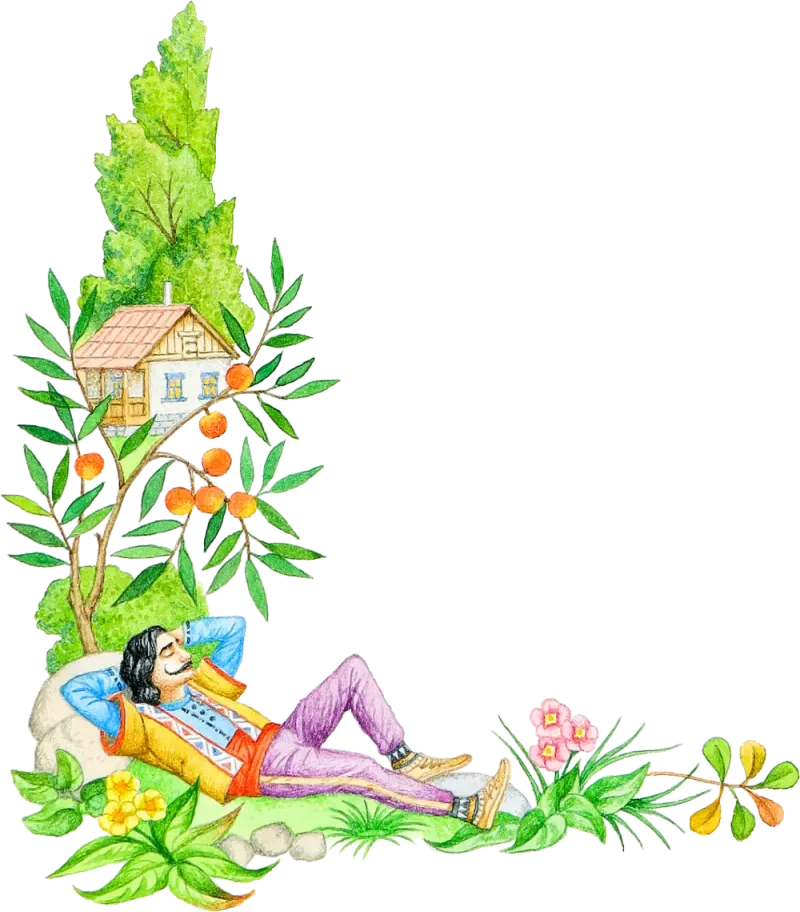
Once upon a time, there was a miserable man by the name of Nazar.
Nazar was an unskilled and lazy man. Most of all he was cowardly, so cowardly that he feared to put one foot in front of the other while alone, even if doing so would save his life. He always stayed by his wife’s side from morning until evening. He only ventured outside the house when with her and then would go right back in when she did. For this he was nicknamed Cowardly Nazar.
One night this Cowardly Nazar followed his wife out to the doorstep. When he saw that it was a bright, moonlit night, he said, “ What a good night it is for robbing someone on the road! I feel an urge to go rob the king whose caravan is arriving from India and bring the plunder home.”
His wife said, “Don’t you be silly and stay put, you would-be caravan robber!”
Nazar replied, “Shameless woman! Why do you hold me back from robbing a caravan and bringing home the plunder? How can I be called a man if I allow such insolence from you?”
While he ranted, his wife walked into the house and locked the door.
“You found it’s a good night for robbing on the road, you cowardly one?”, she said. “Now go ahead and rob your caravan!”
Nazar stood afraid on the doorstep. He begged and pleaded for his wife to open the door, but she refused. In despair, he curled up against a wall and spent the night shivering until morning came.
The morning went on to become a hot, summer day. Offended and cross, Nazar sat against the wall in the blazing sun and waited for his wife to let him inside. Flies buzzed, but he was too lazy to wave them away from his face. The flies landed and gathered all over his nose and mouth. When finally they had pestered him enough, he raised his hand and slapped his own face. The slap killed the flies, which dropped down in front of him.
“Oh, what is this?” he said in surprise.
He wondered how many he had killed with one strike, but he could not count them. He guessed that there must have been one thousand flies at the least.
“I must have always been a mighty man, except I did not know it until now! Why should I sit waiting for this useless woman if I can kill one thousand living creatures with one strike?”
So he got up and went straight to the village priest.
“God bless you, my son!” the priest greeted him.
“Do you know what happened, Father?” Nazar said, and he told the priest his historic feats. Then Nazar declared that he must get away from his wife. He asked the priest to write of his strength and bravery so that everybody could read and know of it.
As a joke, the priest wrote on a piece of a cloth:
The Invincible Hero, Nazar the Brave, If he strikes once, a thousand he’ll break.
And the priest gave it to him.
Nazar tied this cloth onto a stick as a flag, and then he strapped a rusty sword on his back, mounted his neighbor’s donkey, and left the village.
2
He took the first road, despite not knowing where it led.
He rode until, suddenly, he realized he had gone quite far from the village. At that moment fear stuck his heart. He tried to bolster his courage, singing, talking to himself, and speaking harshly to the donkey.
The further he rode, the more frightened he became. The more frightened he became, the louder his voice. He began to shout and scream, and the donkey started to bray. This noise and commotion sent birds flying from the nearest trees. Hares ran from under the bushes, and frogs jumped from the grass into the water.
Nazar’s voice grew even louder when he entered a forest. It seemed to him that behind every tree, bush, and rock there was a beast or bandit waiting to attack him. So he started to shout, and so fiercely! May your ears never hear such noise!
At that very moment a peasant was passing through the forest, leading his horse and minding his own business. But as soon as he heard this terrible voice, he stopped in his tracks.
“Oh, no,” he said. “It must be bandits. I fear I may meet my death today.”
Leaving his horse, he fled the forest on foot.
How lucky for Nazar the Brave! He came shouting and saw a saddled horse waiting for him in the middle of the road. He got off of the donkey, mounted this horse, and continued on his way.
3
After riding, only God knows how far, he found himself in a village. He was unfamiliar with the village and the village was unfamiliar with him. Where should he go, and where should he not?
He heard the sounds of a music, so he rode his horse toward the music and found himself at a wedding reception.
“Good day to you,” he said.
“A guest is always welcomed”, they said to him. Together with his flag they seated him at the head of the table. May your eyes see all the goodness that was spread in front of him, both food and drink!
The wedding guests asked one another about this odd stranger. Someone from the foot of the table tapped the one sitting next to him and asked. In turn, this one tapped the one sitting next to him, and so the guests were tapping and asking each other until the question was put to the priest, who sat at the top corner of the table. The priest read stranger’s flag:
The Invincible Hero, Nazar the Brave, If he strikes once, a thousand he’ll break.
Alarmed, the priest informed the one sitting next to him, who in turn informed the one sitting next to him, until the whole wedding reception echoed with whispers of, ‘Don’t you know the new guest?’
The Invincible Hero, Nazar the Brave, If he strikes once, a thousand he’ll break.
“He is Nazar the Brave, he is!” someone shouted. “How he has changed! I did not recognize him at first.”
And some began to speak of the heroic feats Nazar had performed, their old acquaintanceship, and the days they had spent together.
“Why does a man like this have no servants with him?” some asked in surprise.
“It is his custom. He dislikes traveling with servants. Once I asked him that very question, and he said, ‘Why do I need a servant? The whole world is my servant!’ ”
“Why is it that instead of a proper sword, he has this rusty piece of iron strapped to his back?”
“That is true talent and power, to strike once with this rusty piece of iron and kill a thousand. Think of what it should take for a common man to kill a thousand, even with a good sword!”
So the astonished guests stood and drank to Nazar the Brave’s health.
The smartest of the guests made a speech in front of Nazar and proclaimed, “We first heard of your great fame long ago. We were eager to meet you, and here today we are fortunate to do so.”
Nazar sighed and waved his hand. The people winked at each other, for they understood how much that sigh and wave must mean.
And at once the wedding musician wrote a song and sang,
‘We welcome you one thousand times, The powerful eagle of our mountains, The crown and the pride of our land, Invincible Hero, Nazar the Brave, If you strike once, a thousand you’ll break.
A support you are to the poor and weak, You will free them from all the pain, You will save us from the unjust, Invincible Hero, Nazar the Brave, If you strike once, a thousand you’ll break.
We will die for your flag, For the sword on your back,
For the horse that you ride, For its hooves, tail and mane, Invincible Hero, Nazar the Brave, If you strike once, a thousand you’ll break.’
And returning to their homes, the drunken wedding guests spread the word that he had come,
The Invincible Hero, Nazar the Brave, If he strikes once, a thousand he’ll break.
They told of his extraordinary heroism and described his majestic appearance, and people everywhere began to name their newborn babies Nazar the Brave.
4
For his part, Nazar left the wedding reception and continued on his way.
He rode until he reached a green field. He left his horse to graze, planted his flag in the ground, and lay down to sleep in its shade.
It just so happened that there were seven giant bandits, brothers, and all this area belonged to them. Their castle sat atop the nearest mountain, and from their high perch, these giants saw that a man had come and lay down in their field. They were amazed, marveling at the warrior spirit this man must have, for he had come and calmly lay down in their field without any apprehension. He had even let his horse loose.
Each of these giants had a mace that weighed a thousand pounds. They took up these weapons and went out to meet him.
And what did they see when they arrived? They saw a horse grazing and a man sleeping, and next to the man’s head was a flag planted in the ground, on which was written:
The Invincible Hero, Nazar the Brave, If he strikes once, a thousand he’ll break.
And so, this was Nazar the Brave. The giants bit their fingernails and were frozen in their places. You see, the drunken wedding guests had spread the rumors of this valiant conqueror, and their reports had also reached the bandits’ ears.
Their mouths dry with fear, the bandits waited until Nazar finished his sleep and woke up. When Nazar opened his eyes and saw seven enormous giants standing over him, their thousand-pound maces on their shoulders, his heart sank.
He hid behind his flag and trembled, shaking like an autumn leaf. When the giants saw how he quaked, they cried, “He has grown angry, and now he will kill all seven of us with one strike.”
The seven bandits knelt before him and pleaded, “We have learned of your terrifying name. We were eager to meet you, and today we are fortunate you have come to our land on your own. We are your humble servants, we seven brothers, and our beautiful sister is in our castle on that mountaintop. We beg of you,
The Invincible Hero, Nazar the Brave, If you strike once, a thousand you’ll break.
Do us the pleasure, please, of coming and sharing our bread.”
Here Nazar caught his breath and mounted his horse. The brothers carried his flag and led him to their castle. They welcomed him in, served him, and paid tribute to him with toasts fit for a king. They talked of his heroic feats with respect and honor, and they praised him so much that their beautiful sister fell in love with him.
5
Meanwhile, a tiger appeared in the land and had the people in a state of panic.
Who would kill the tiger? Who was even capable of doing so? Nazar the Brave, of course! Who else had the courage to go up against a tiger?
And everybody looked to Nazar. To them, there was one God in heaven, and one Nazar the Brave on earth.
No sooner had Nazar heard about the tiger than he wanted to run away and go home. However, the people and the giant brothers thought he was running to go kill the tiger.
His fiancée stopped him, exclaiming, “Where are you running off to like that without a gun? Take a gun with you, and then you can leave.”
She fetched a gun for him so that he could go add another heroic tale to his glory, so Nazar took the gun and left.
He went to the forest and climbed up a tree to hide, hoping that he and the tiger would never meet. But when he crouched in the tree, he was horror-struck. His spirit shrank to the size of a pea.
As luck would have it, the cursed tiger had lain under that very tree. As soon as Nazar saw the tiger, his heart sank. His arms and legs grew weak, and he fell from the tree, landing right on top of the ferocious beast.
The furious tiger leapt up and ran, with Nazar clinging to its back in fear. It ran so fast, over mountains and through the valleys and forest. And when the people saw him, ah! Nazar the Brave was riding the tiger!
“Come and see!” the people shouted. “Nazar the Brave has made the tiger his horse and is riding it. Let us go and defeat it!”
Everybody was inspired by Nazar’s courage and went put to fight the tiger from all sides. With screams and laughter, they attacked the tiger with rocks, sticks, daggers, swords, and guns until at last they had killed the creature. Their victory brought Nazar back to his senses, and he was able to speak again.
“What a pity!” he said. “Why did you kill it? I had made it my horse and mounted it with great effort. I had to ride for such a long time.”
The news of Nazar’s triumph spread and reached the village. Men and women, young and old all poured outside to welcome Nazar with song.
In this world, Among all people, Who can equal you? Oh, brave Nazar!
Like a kite bird, Like lightning and fire, You rushed down from the high castle.
You came and saved us, Oh, brave Nazar!
The fearful tiger You made your horse, You mounted and rode it
From mountain to mountain, Oh, brave Nazar!
You saved us, You freed us, Glory and pride to you for centuries, Oh, brave Nazar!
Then Nazar the Brave was wed to the giants’ beautiful sister. They celebrated the wedding for seven days and seven nights and praised the king and queen with songs.
‘The moon has just gone up the mountain, Who does it look like?’
‘The moon has just gone up the mountain, It is Nazar the Brave.’
‘The new sun is shining, Who does it look like?’
‘The new sun is shining, It is his dear love.’
‘Our king was red, And his sun was red, His crown was red, hey red,
The queen was in red, hey red, Hello to the queen in red,
Congratulations, congratulations, Congratulations to Nazar the Brave, Congratulations to his dear love, And congratulations to the whole world.’
6
Now, the king of a neighboring country wanted to marry the giants’ beautiful sister. When he found out that she had married another man and not him, he gathered his armies and declared war with the seven brothers.
The seven giants went to Nazar the Brave. They told him the king’s plans, bowed to him and asked for his orders. When he heard about the war, Nazar was dismayed. He slipped out to run back to his village. But the people thought he was running to attack the king’s army.
They blocked his path and asked, “Where are you going, alone and unarmed? What are you doing? Have you become bored with your life?”
The people brought him weapons, but his wife was charmed with his heroism and asked her brothers not to let Nazar attack the king’s army alone.
This news soon spread. It reached the soldiers, and then the people, and finally spies took this report to the king. They told him that Nazar the Brave was dashing towards the battlefield alone and unarmed, and that his men had barely managed to hold him back, and that now he and his men were coming in a great throng.
They brought a wild stallion to the battlefield and seated Nazar on it, and the inspired soldiers went with him, shouting loudly, “Long live Nazar the Brave! Death to the enemy!”
When Nazar’s stallion realized what a useless man was sitting on his back, the horse neighed and galloped straight towards the king’s army. The soldiers thought that Nazar the Brave had started the attack, so they roared, ‘Hurrah!’ and followed him, attacking in frenzy.
When Nazar realized that he could not keep hold of the horse’s head and was about to fall, he stretched out his arms to wrap his hands around a tree branch. It happened that the tree was rotten, and a branch the size of a log broke off in his hand.
The king’s soldiers had heard of Nazar’s fame, and their hearts were already filled with fear, but when they saw all this, they grew so terrified that they retreated and ran away as fast and far as they could.
“If you are human, run away!” they shouted. “Nazar the Brave is coming, and he is uprooting the trees!”
Many of the king’s soldiers laid their swords at Nazar the Brave’s feet in surrender.
And so Nazar the Brave left the awful battlefield and returned to the giants’ castle.
The people raised triumphal arches and appeared before him with exquisite joy, with hurrays and bravos, with songs and music, with girls and flowers, with tributes and speeches. Such glory and praise left Nazar in awe.
The people proclaimed him their king, seating him on the royal throne. Nazar the Brave gave each of those giants a royal title and position.
And suddenly he saw that the world was in the palm of his hand.
They say Nazar the Brave lives and reigns until today. And when someone talks with him about heroism, intelligence and talent, he laughs and says, “What heroism? What intelligence? What talent? That is all nonsense! All that matters is a a person’s luck. If you have luck, you should feast and celebrate.”
And they say that until today, Nazar the Brave feasts and laughs at all the world.
Publication details
- Title
- Nazar the Brave
- By
- Hovhannes Toumanyan (1869–1923)
- Length
- 21:23
- Narrated by
- Travis
- Language
- English
- Publisher
- Varbo Records
- Release
- 2016
- ISRC
- QZ4VQ1600007
- Copyright
- 2016 © Varbo Corporation
All rights reserved.